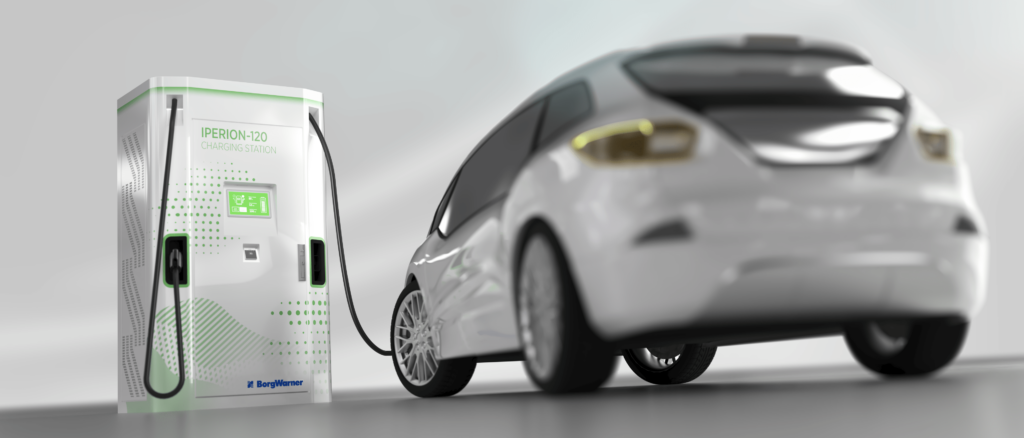
BorgWarner Launches High-Altitude Charging Station

With charging capacity increasingly seen as a limiting factor in the growth of EV markets around the world, BorgWarner Systems has been sharing more details about its new Iperion 120, a 120 kW charging station designed to form the heart of its efforts to create modern charging infrastructures (writes Peter Donaldson).
A key feature is that it can be used in a wide range of environments, including in temperatures from -30 C to +50 C and altitudes up to 4000 m. As Davide Spazian, charging account manager for BorgWarner Systems, explains, “A maximum operating altitude of 4000 m might look too much, but our philosophy is to deliver as many charging points as possible, so we don’t want to put any limitations on where they can be installed. Whereas our competitors’ systems basically stop at below 2000 m, ours can be installed even higher with no power de-rating at all.”
Altitude affects conventional charging stations and high-voltage power conversion equipment generally because of their reliance on air as an insulator between key components. The insulating properties of air degrade as density falls with increasing altitude, so design regulations for equipment designed to operate in low air density mandate greater separation between components and conductors, which tends to make equipment bulkier.
Air’s ability to carry heat away also falls with its density, which tends to push engineers into incorporating larger heat sinks, increasing airflow or even de-rating the power available from the equipment at altitude.
Spazian says the Iperion 120 is capable of delivering its full 120 kW, even at 4000 m, to a single vehicle or it can split the delivery into 60 kW per side to charge two vehicles simultaneously.
The charger has two big input transformers that guarantee galvanic insulation from the grid and between the vehicle(s), Spazian explains. The transformers send AC power to dual interlinked rectifier bridges that feed a DC bus, and the power is then sent to the vehicle(s) plugged into the charger.
The charger also includes DC-DC converters built using IGBT technology. “We are considering moving to silicon carbide, but currently we prefer to rely on a well-known technology that in our experience has a very low failure rate, so that is why for the time being we are releasing the unit with IGBTs,” Spazian says.
He adds installation is straightforward, as inside the Iperion 120’s case there is a terminal block for connecting three-phase power as well as an internet connection.
A magnetic cut-out severs the connection to the grid in case of any safety problems, and while demonstrator versions do not have a user-operable emergency button the production version will, Spazian says.
The system is also designed to be compatible with Open Charge Point Protocol 2.0.1. “That enables the charging station to be fully controlled remotely by a server that is compatible with that standard, including automatic power management directly from the server,” Spazian says. “That means it can shape the charging performance to the vehicle while also considering the demand on the grid.”