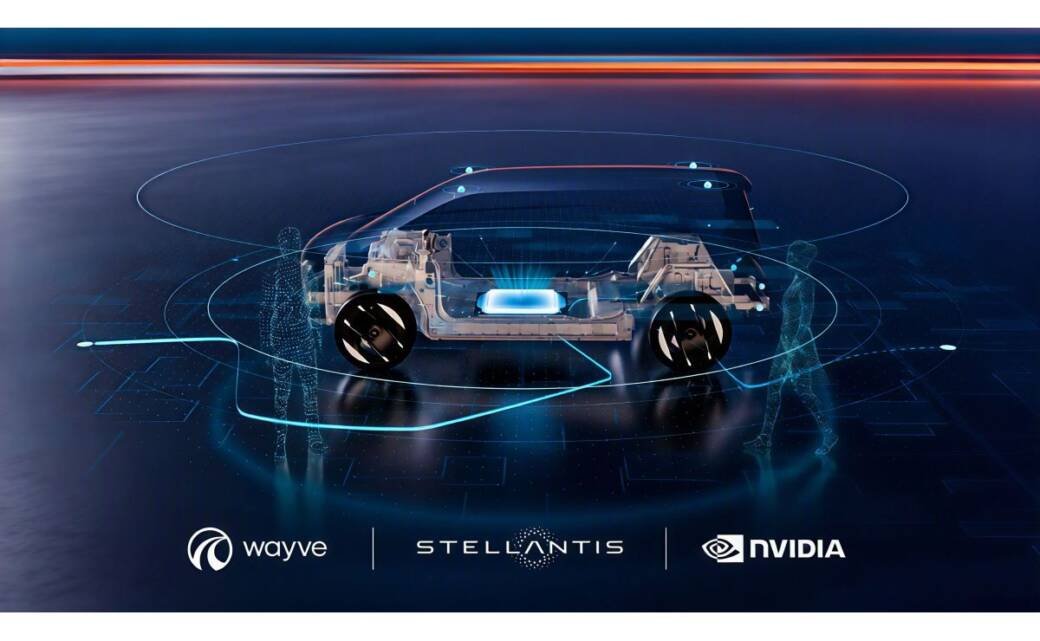
Wayve, NVIDIA and Stellantis have announced a strategic collaboration with the French Government to accelerate autonomous vehicle development and deployment in France and across Europe, combining artificial intelligence, advanced computing and vehicle engineering expertise.
- Wayve AI Driver Integrates NVIDIA Technology
- Stellantis Provides Level 4-Ready Vehicle Platforms
- France Strengthens Its Position in Autonomous Mobility
- French Government Supports Safe Autonomous Vehicle Deployment
- Local Partnerships Focus on Workers and Communities
- Industry Leaders Highlight AI-Powered Mobility Potential
- Collaboration Aims to Accelerate Autonomous Driving Across Europe
London-based autonomous driving technology developer Wayve has joined forces with NVIDIA, Stellantis and the French Government to advance the deployment of autonomous vehicles in France. Announced at the Assises du Véhicule Autonome, the collaboration aims to establish a comprehensive ecosystem for AI-powered mobility while supporting the safe and responsible introduction of autonomous driving technologies across the European Union.
The initiative brings together Wayve’s embodied AI driving technology, NVIDIA’s advanced computing architecture and Stellantis’ vehicle engineering and manufacturing capabilities. By integrating these technologies, the partners aim to position France as a major European hub for autonomous mobility development, covering the entire value chain from semiconductor technology to vehicle production.
Wayve AI Driver Integrates NVIDIA Technology
At the center of the collaboration is the Wayve AI Driver, an artificial intelligence-based autonomous driving system designed to support automated vehicle operations. The technology will integrate NVIDIA Halos OS and operate on the NVIDIA Hyperion compute and sensor architecture, providing the computing foundation for autonomous driving capabilities.
The system will be combined with Stellantis’ L4-Ready Platforms™, which are designed to support Level 4 autonomous driving applications. Under Level 4 automation, vehicles can perform driving tasks without human intervention within defined operational conditions, making the technology particularly relevant for future autonomous mobility services.
Stellantis Provides Level 4-Ready Vehicle Platforms
Stellantis will contribute its automotive engineering, manufacturing expertise and L4-Ready vehicle platforms to the initiative. These capabilities will help integrate Wayve’s AI driving system and NVIDIA’s computing technologies into vehicles designed for autonomous operation.
The collaboration builds on existing relationships among the partners and aims to accelerate the development of commercially viable autonomous driving solutions. France, already an important engineering and technology development center for Stellantis, will serve as a key location for advancing the project.
France Strengthens Its Position in Autonomous Mobility
France has emerged as an important European market for artificial intelligence and advanced mobility technologies. The country hosts one of Europe’s largest ride-hailing markets and organized the AI Action Summit in Paris, where €109 billion in AI investment was announced in 2025.
The new partnership seeks to build on this environment by creating an integrated autonomous vehicle ecosystem involving technology developers, automotive manufacturers, public authorities and mobility service providers. The initiative also aims to strengthen Europe’s ability to compete in the global autonomous driving industry.
French Government Supports Safe Autonomous Vehicle Deployment
The French Government will play an important role in supporting the development of an appropriate regulatory environment for autonomous vehicles. French Minister of Transport Philippe Tabarot emphasized the country’s commitment to accelerating autonomous mobility while maintaining strict requirements for safety and data sovereignty.
According to Tabarot, cooperation between technology companies, automotive manufacturers, trade unions, city authorities and mobility stakeholders will be essential for transitioning autonomous vehicles from testing programs to real-world deployment. The collaboration is intended to establish a framework for responsible technological development.
Local Partnerships Focus on Workers and Communities
Beyond technological development, the initiative emphasizes cooperation with local French partners to support the practical deployment of autonomous mobility services. Transport operators and local stakeholders will lead engagement with trade unions, municipal authorities and mobility organizations.
This approach aims to ensure that the introduction of autonomous vehicles considers the needs of workers, passengers and communities. By involving local partners in deployment planning, the collaboration seeks to address operational and social considerations alongside technological advancement.
Industry Leaders Highlight AI-Powered Mobility Potential
Kaity Fischer, Vice President of Autonomous Mobility & Operations at Wayve, described France as an important market for autonomous vehicle development. She emphasized that cooperation with the French Government and industry partners would help establish a framework for deploying autonomous driving technology safely and responsibly throughout France and the European Union.
Anne Laliron, Senior Vice President of Technology Research at Stellantis, highlighted the potential for autonomous driving to improve mobility safety and convenience. Meanwhile, Ali Kani, Vice President of Automotive at NVIDIA, emphasized the importance of combining Wayve’s embodied AI, NVIDIA Hyperion and Stellantis’ automotive expertise to establish a foundation for autonomous mobility in Europe.
Collaboration Aims to Accelerate Autonomous Driving Across Europe
The partnership between Wayve, NVIDIA, Stellantis and the French Government represents a coordinated effort to advance autonomous vehicle technology from development toward practical deployment. By combining AI software, advanced computing systems, vehicle platforms and regulatory cooperation, the initiative aims to address several of the challenges associated with introducing Level 4 autonomous mobility.
With France serving as the central development ecosystem, the collaboration could contribute to the broader expansion of autonomous driving technologies across Europe. Its long-term success will depend on technical validation, regulatory approvals, infrastructure readiness and cooperation with local transport stakeholders.