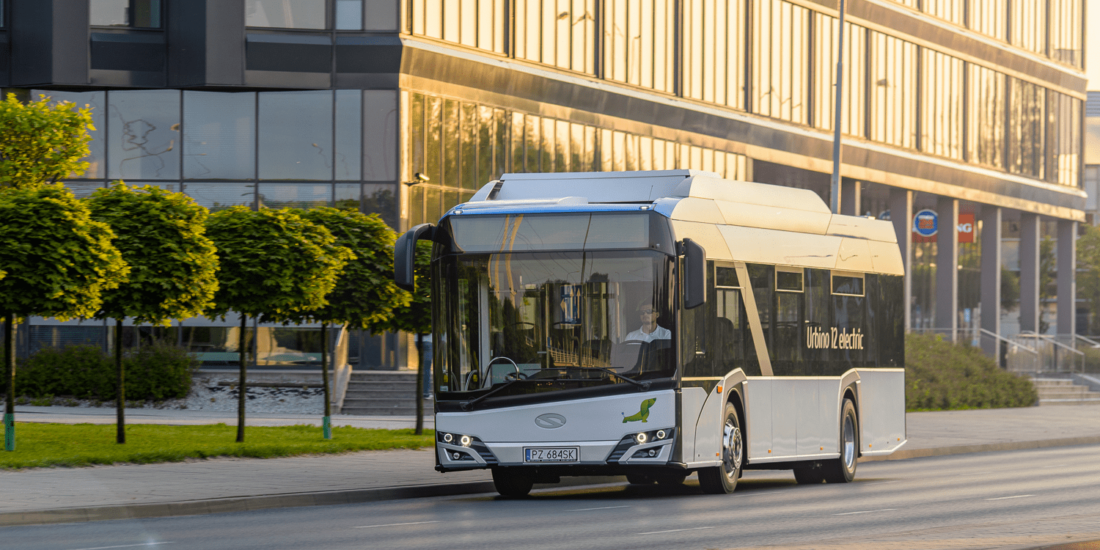
The bad air in many Polish cities has meant that domestic demand has been high for years. Now, the interest in the rest of Europe is also showing a significant increase. Over the last few years, Poland has developed into one of the leading manufacturers of electric buses on the continent. Only recently, a pantograph charging station for electric buses with up to 540 kW was put into operation in the Polish city of Poznań (Poznan). This flagship project is part of a booming development of the electric bus industry. Particularly successful is the Polish company Solaris, which produces electric buses near Poznań and now wins around a quarter of all tenders in Europe.
But other companies, such as Volvo, also rely on locations in Poland for the development and manufacture of electric buses. Ulf Magnusson, Managing Director of Volvo Polska, explains the positive market development with the presence of the most important local bus manufacturers and the strong demand for low-emission buses in the Polish cities affected by smog. Added to this are the good financial possibilities of the local transport companies, which will be able to renew their outdated fleets not only through increasing revenues but also through additional EU funding. This applies, for example, to Lublin. Located in the east of the country and with over 320,000 inhabitants, the city acquired 20 Solaris electric buses and the necessary charging infrastructure from Solaris for 62 million Złoty, which corresponds to around 15 million euros.
The Polish Statistical Office announced for 2018 that the share of electric buses manufactured in Poland this year accounted for 36 per cent of sales in the EU. Sales in Poland are expected to increase further in the coming years, as 62 local authorities have currently expressed interest in climate-friendly vehicles for public passenger transport. The high level of air pollution in Polish cities is forcing the public sector to make further investments in environmentally and climate-friendly transport solutions. The Polish Industrial Development Agency (ARP) estimates that 800 electric buses will be needed in the coming years.
Solaris wants to profit from the Polish electric bus boom
Solaris is also expected to benefit disproportionately from this growing demand. Current orders from Poznań, Warszawa (Warsaw), Lublin but also Berlin and Milan have shown that Solaris electric buses are particularly in demand in large cities. According to its own information, the Polish company has already sold more than 300 electric buses in the current year.
Solaris has been relying on electric drives since 2001. At that time, the company sold its Trollino trolleybuses primarily to Polish and Eastern European customers. The success of the battery-powered “Urbino electric” bus, which emerged from the low-floor “Urbino” city bus model built in 1999, began in 2011. Today it is the company’s best-selling model.