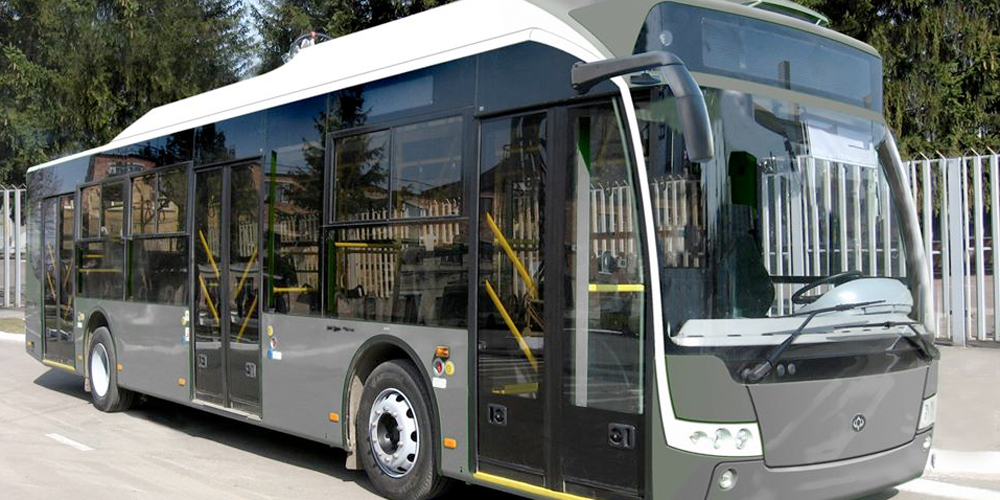
Since the beginning of the 2010s, the press in Ukraine has been reporting more and more about such initiatives, which have resulted in the first prototypes of Ukrainian electric buses. However, after the manufacturer Electron succeeded in 2015 in building an electric city bus and integrating it into the conventional urban transport system of the city of Lviv, the other companies have intensified their efforts. At the end of last year, Bogdan presented plans for the first electric city bus developed entirely in-house. Production is due to start this year. The main challenge that Bogdan had set itself in its first own design of an electric bus was the self-imposed goal of designing the buses to have a range of 200 km. The drive motor with an output of 260 kW makes it possible to reach a speed of over 70 km/h. The 12-metre long prototype will be able to carry around 80 passengers.
Bogdan has also become known in Poland as a manufacturer in connection with the delivery of trolleybuses to Lublin. Bogdan worked together with the Polish company Ursus in this project. “Lublin is one of the three Polish cities, along with Tychy and Gdynia, that rely on trolleybuses. A total of 124 trolleybuses made by Ursus and Solaris are in operation in the city. The vehicles produced by Ursus in cooperation with Bogdan are just as convincing as all the others,” said Weronika Opasiak, press officer of Lublin’s transport authority.
Technical outlook
The development of a dedicated electric bus is intended to give Ukrainian companies new perspectives. One option for the future is to export e-buses from Ukrainian production to the European Union. The Polish expert and editor-in-chief of the specialist portal infobus.pl, Aleksander Kierecki, is cautiously critical of their possible chances of establishing themselves on the European market: “The Eastern manufacturers still have some catching up to do in the areas of marketing, contract compliance and above all technical deficits in batteries. They are currently resorting to non-certified Chinese batteries, which are not generally not considered trustworthy by Western customers.
In the first step, however, Bogdan aims to focus on the domestic Ukrainian market. Here the company’s chances are not bad. With the support of the European Investment Bank and the European Bank for Reconstruction and Development, funds amounting to 160 million euros have been made available for public transport investments. In 2018 alone, Ukrainian cities and municipalities have purchased 269 new city buses. The western Ukrainian city of Lviv counted several tender rounds in 2018, in which a total of 150 buses were purchased. The Belarusian manufacturer MAZ was awarded the contract for 100 city buses and 50 buses went to the Ukrainian manufacturer Electron, which manufactures its buses in Lviv. Since 2015 the electric prototype Е19101 of Electron has been in operation in Lviv. This electric bus has a range of up to 200 km, provided it does not travel faster than 70 km/h, according to the official statement. Although most of the investment funds are spent on city buses with conventional propulsion systems, there are opportunities for electric buses here too. As the Ukrainian news agency UNN reports, in 2019 alone, the cities of Lviv, Kyiv, and Schytomyr tested electric vehicles for their urban transport services.
The Ukrainian potential has already been recognised. Last year, the Chinese electric bus manufacturer Skywell showed increased interest in relocating part of its electric bus production to Ukraine. Although the company remained vague about the concrete timetable and scope, it emphasised the possibility of establishing a Ukrainian-Chinese company.
Less encouraging for Ukrainian bus manufacturers, however, are recent press reports and rumours that talks have already begun with the Polish manufacturer Solaris for the purchase of ten electric buses in the city of Zaporizhzhya. The electric future of Bodgan, Electron and Co., therefore, remains uncertain for the time being.
About the author
Aleksandra Fedorska is a Polish-German political scientist and publicist. She works as a correspondent for Polish and German media in the fields of energy policy and e-mobility. Fedorska lives and works in the German town of Jagel in Schleswig-Holstein and the Polish city of Poznań. Most recently she reported for electrive on the subsidy programme for electric vehicles in Poland and the country’s utility Rafako turning bus builder.