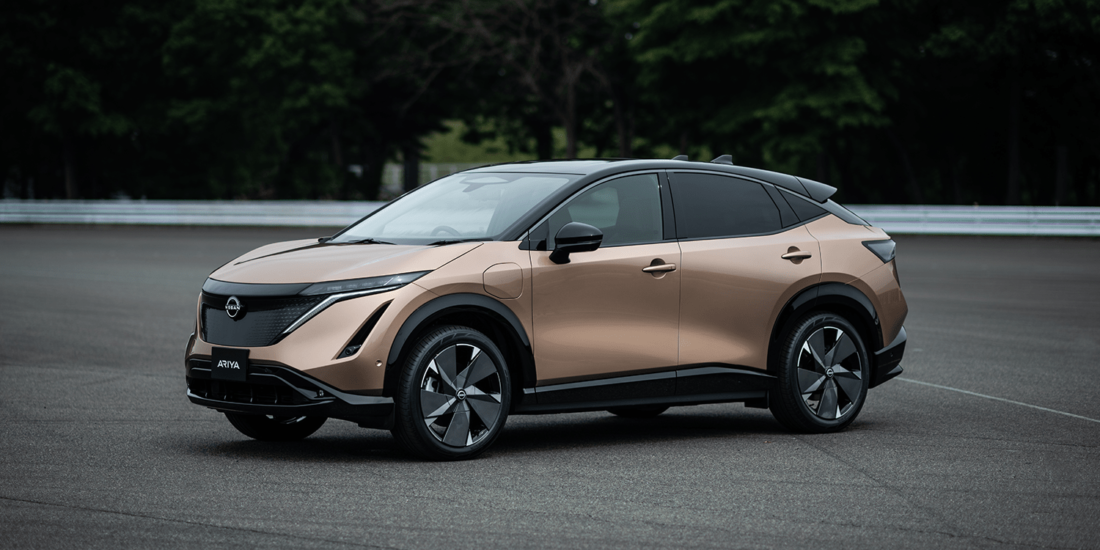
Indeed, Nissan is determined to turn a new leaf (excuse the pun) with the launch of the Ariya crossover set to hit the European market by mid-2021. The production version of the new e-SUV that made its virtual debut at the soon-to-open Nissan Pavilion in Yokohama, Japan, today, is “heavily based” on the 2017 IMx concept, admits Nissan, who had previewed a production nearer version again in 2019. Then called Ariya, the eSUV with bold lines already featured the “bespoke platform” as Daniele Schillaci, Nissan’s executive vice president for global marketing and sales revealed back then. At the digital roundtable we took part in today, Product developer Marco Fioravanti even mentioned the idea going back to 2016. Rather than to “benchmark premium competitors” – think Tesla Model Y, VW I.D.4, Ford Mustang Mach-e or BMW iX3 – Nissan wanted to set their standards, guided by customer needs, stresses Fioravanti.
Four years later, this new architecture is to serve the entire alliance, that is Renault eventually and primarily Nissan in Europe. Considering the Alliance’s recent restructuring announcements, the latter focus comes as a surprise. Nissan was to concentrate on the Asian and North American market with rumours going as far as to say they would withdraw from the continent. However, Fioravanti put the Leader-Follow-Approach in a more relative light. Says Fioravanti: “Just because Renault has been named the leader in this region, does not mean that Nissan has given up.” And, he emphasises that indeed Ariya is “the first EV on this new platform”. So for now, it will be Nissan leading the C-Segment platform. More so, Nissan has “no plan to reduce our model range in Europe,” Fioravanti said, adding that “it will be the opposite” once the Ariya arrives.


Only for electric cars, however. Asked why the company chose to opt for this EV-only approach for its new architecture rather than the multi-energy approach such as PSA for example, Firoanti told electrive: “Yes, it would have been much cheaper to do a multi-energy use platform.” However, it is not “masochism” on Nissan’s behalf, he said, but dedication to a platform that “allows us to take the customer approach and push the wheelbase to an extreme level.” An investment that they hope will be “fully recognised”. Nissan calls this “Timeless Japanese Futurism” both in technical as well as visual terms.
The new Nissan technology
We will get back to the design a bit later. First, however, Nissan finally revealed data on the actual drive technology. As suggested before, the Ariya utilises a new drive called e-4ORCE. There is an all-wheel-drive and also front-wheel-drive-only variant — two in fact when taking the two battery versions of 63 kWh and 87 KWh into account. Nissan is quoting the useable capacity here not the gross that is at 65 and 90 kWh respectively.
The combination of two motor set-ups and two batteries brings the Nissan offer to five core models in Europe, including one Performance option.
The Ariya 63kWh two-wheel-drive model targets urban commuters with an output of 160 kW and a top speed of 160 kph. Nissan claims a range of 360 km for the entry model. Interesting, the next trim, the Ariya 87kWh in the 2WD set-up has the most extended range of all the variants with 500 km and has a 178 kW output.
Only in the 4WD set-up, Nissan will offer the 87 KWh Performance version. It features the highest output with 290 kW powertrain and but compromises slightly on the range at 400 km due to the higher power. Said power serves for acceleration from 0-100 kph in 5.1 seconds, 0.6 seconds faster than the next strongest variant. The standard 87 kWh EV with AWD claims 460 km, while the smaller battery in the AWD version is to last for 340 km. All come at a top speed of 200 kph.

Given this reasonably impressive spec, it becomes clear why Fioravanto considers the Ariya and Leaf “fully complementary,” and targeting two different segments of the market. He described these as the Ariya moving up in the food chain if you like, serving as the “first car in the household” (and making the Leaf the second).
Talking about moving up in the world – the new battery in the Ariya is Nissan’s most awaited and expected clue. It is finally liquid-cooled, something that has been missing dearly in all previous Leaf updates. Again Fioravanti points out that they have listened to customers and makes a plea to the press to establish a point Nissan is wanting to make: “We are simply confident that the battery will become an accessory element – the battery is not differentiating.”
While European buyers will rejoice that Nissan finally complies with the Combined Charging System (CCS), thus moving away from the Leaf’s ChaDeMo (and the V2G projects), the charging performance remains rather unimpressive in some variants. The smaller battery version vehicle comes with a 7.4 kW charger for domestic use. Only the stronger 87kWh variants include a 22kW 3 phase charger for home charging, although in Germany, Nissan already moved to include 22 kW in all options so we expect to see this in other markets too. However, the Ariya generally supports quick charging up to 130kW. That means adding about 360 km in range in half an hour.